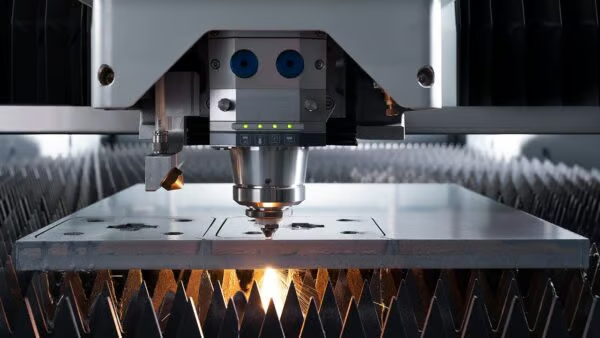
Advancements in Laser and Plasma Cutting Technologies in Metal Industries
The metal fabrication industry has experienced significant technological development in recent years. Laser and plasma cutting technologies have become essential solutions for manufacturers seeking high accuracy, faster production, and consistent results.
Modern metal fabrication is no longer limited to traditional cutting methods. Advanced cutting systems can produce complex geometries, precise dimensions, and detailed components while reducing material waste and production time.
Laser Cutting in Metal Fabrication
Laser cutting uses a highly concentrated beam of light to heat and cut metal according to a programmed design. The technology is known for its precision and ability to produce complex shapes, openings, and detailed components with high-quality edges.
Laser cutting can be used for manufacturing:
- Metal sheets and components.
- Engineering structures and parts.
- Production line components.
- Metal covers and doors.
- Industrial equipment components.
- Precision parts requiring accurate dimensions.
Plasma Cutting Technology
Plasma cutting uses a high-temperature electrical arc to melt and remove metal at high speed. It is suitable for a wide range of industrial applications and can be used with different material thicknesses.
Key advantages of plasma cutting include:
- Fast cutting speeds.
- Ability to handle different material thicknesses.
- Capability to produce various engineering designs.
- Reduced manufacturing time.
- Suitability for industrial and large-scale projects.
The Importance of Precision
Precision is one of the most important factors in successful metal fabrication. Even a small dimensional variation can affect assembly, alignment, or the operation of industrial equipment.
Modern fabrication processes therefore rely on digital designs and computer-controlled cutting systems, allowing engineering drawings to be converted into accurately manufactured components.
Reducing Waste and Improving Productivity
Efficient cutting plans allow manufacturers to make better use of metal sheets and reduce material waste. This directly contributes to lower production costs and improved manufacturing efficiency.
Modern cutting equipment can also reduce processing time, allowing manufacturers to increase production capacity and meet project schedules more effectively.
Selecting the Right Cutting Technology
There is no single cutting technology suitable for every application. The choice between laser and plasma cutting depends on material type, thickness, required accuracy, design complexity, production volume, and project requirements.
- Material type: Steel, stainless steel, and other metals may require different approaches.
- Material thickness: Thickness is an important factor when selecting the cutting method.
- Required precision: Detailed components may require highly accurate cutting.
- Production volume: Requirements vary between small and high-volume production.
- Final application: Structural components have different requirements from precision parts.
Integration with Other Fabrication Processes
Cutting is not an isolated manufacturing operation. It is part of an integrated process that may include engineering design, material selection, cutting, forming, welding, assembly, and finishing.
Proper integration between these stages helps produce reliable components with the required dimensions, quality, and performance.
Laser and plasma cutting technologies represent an important step toward more accurate and efficient metal fabrication. As industrial requirements continue to evolve, advanced cutting solutions provide manufacturers with greater flexibility and production capabilities.